[How Privacy Boost Works #4]: Portal Address - What If Your Private Account Had a Deposit Address?
![[How Privacy Boost Works #4]: Portal Address - What If Your Private Account Had a Deposit Address?](/_next/image?url=%2Fblog-portal-address.png&w=3840&q=75&dpl=dpl_7gWa5LyjeNv1PS4HtcyzRSEQW4Kp)
Think about how you deposit tokens into an exchange. You check the network and token, then send your assets to the deposit address provided by the exchange. Once the deposit is processed, your account balance is updated. You do not need to know how the exchange detects the deposit or assigns it to your account.
It is a familiar experience. However, funding a private account in privacy protocols often requires a separate workflow. You open a dedicated interface, connect your wallet, and approve a deposit transaction. If the service you are sending from only lets you specify a recipient address, that workflow may be incompatible with its withdrawal process.
Why should funding a private account be any more complicated than depositing into an exchange?
Privacy Boost V2's Portal answers that question. Set up a deposit address linked to your private account, then send assets to it. Once the deposit is processed, the assets appear in your private balance.
1. All you need is a deposit address
The user's goal is simple: move assets from somewhere else into their account. There should be no need to learn a protocol-specific workflow every time.
The difference becomes especially clear when withdrawing from an exchange. A withdrawal interface typically lets you choose a network, a token, and a recipient address. It generally offers no way to call a specific deposit function on a smart contract. When a deposit requires that kind of contract interaction, users may have to withdraw to a personal wallet first and then make a separate deposit.
Portal connects these systems through an address that accepts ordinary token transfers. As long as the network, token, and sending service's withdrawal requirements are compatible, you can use your Portal address as the recipient. The same approach works when moving assets from another wallet or receiving a payment.
An initial setup is required to create your Portal. After that, you can reuse the same address without creating a new request or coming online to sign for every deposit.
2. A deposit address for your private account
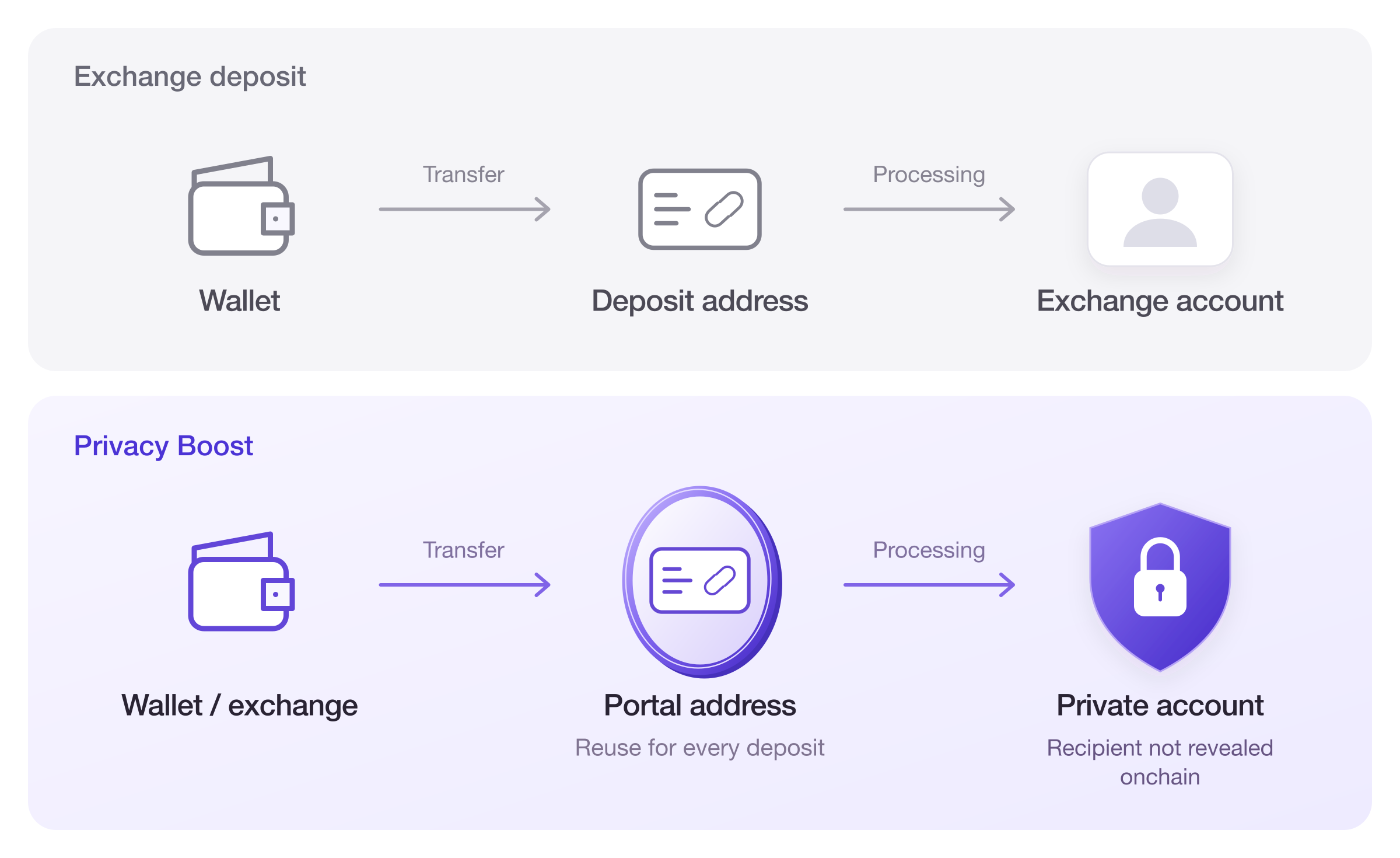
Portal is a reusable public deposit address linked to a Privacy Boost account. Just as an exchange deposit address routes funds to your exchange account, assets received by your Portal are credited to your Privacy Boost account's private balance.
The sender only needs to make an ordinary token transfer. They can do so without constructing a Privacy Boost-specific transaction or knowing the recipient's private address. Once assets arrive at the Portal, they can be moved into the pool and credited to the account without the user coming online to sign for each deposit.
Your Portal address is the public entry point to your private account. Anyone can send tokens to it, but public onchain records do not reveal which private account receives them. This gives you a familiar way to deposit assets while keeping your account's identity private.
3. A real deposit from Binance to Privacy Boost
Let's look at an actual deposit on Base. On September 15, 2026, an address labeled Binance: Hot Wallet 34 on BaseScan sent 100 USDC to the Portal address 0xe151C38c92C8978bD1d983Ac822f5CcFbE86C0Fd.
The token transfer records for the Binance transaction show 100 USDC moving from the hot wallet to this address. There was no intermediate withdrawal to a personal wallet before depositing into Privacy Boost.
The Portal's 100 USDC then moved into the Privacy Boost pool, and the deposit was credited to the private balance. The onchain records show the following sequence.
- 17:42:05 UTC — Exchange withdrawal. Binance hot wallet → Portal: 100 USDC transferred.
- 17:44:37 UTC — Sweep transaction. Portal → Privacy Boost pool: 100 USDC moved.
- 17:44:43 UTC — Deposit completion transaction. Deposit proof verified and private note added.
In this example, the user only needed to specify their existing Portal address as the withdrawal recipient. Privacy Boost handled the subsequent processing.
The public records show that this Portal received 100 USDC and deposited it into Privacy Boost. Those records alone do not reveal which internal PB address owns the assets.
The deposit record contains a cryptographic value used to verify the recipient, while the internal PB address remains concealed. That value incorporates a private random value, so even an observer who already knows an internal PB address cannot simply plug it in to check which Portal it belongs to. The proof verifies that the assets are credited to the correct account while keeping that account private.
An observer can therefore connect the transfer from the exchange to the Portal, the movement from the Portal into the pool, and the deposit completion record. The creation of a new note is also public. However, those records do not provide the same visibility into the note owner's internal PB address, the account's full balance, or its subsequent private transfers.
This is the privacy Portal provides alongside the convenience of depositing directly from an exchange. The exchange still knows its withdrawal customer and the recipient address, and external clues such as amounts and timing may support inferences. Portal protects against directly linking a Portal to an internal PB address using public onchain records alone.
4. A familiar way to fund a private account
In this example, Binance required no dedicated Privacy Boost deposit integration. Its existing withdrawal functionality sent tokens to the Portal address, and subsequent processing credited them to a private balance. Users can follow the same approach to move assets from a supported wallet or share their Portal address to receive payments. The network, token, and sending service's withdrawal requirements must still be compatible.
When privacy requires a special deposit procedure every time, users have to bridge that gap whenever they bring assets into the system. Portal turns the familiar act of sending to a deposit address into a way to fund a private balance. Adding assets to a Privacy Boost account should feel just as natural.
See Privacy Boost in action
Explore the privacy infrastructure behind confidential onchain finance.
Read next
![[How Privacy Boost Works #3]: Using Private Assets in DeFi Without Leaving the Pool](/_next/image?url=%2Fblog-external-gateway.png&w=3840&q=75&dpl=dpl_7gWa5LyjeNv1PS4HtcyzRSEQW4Kp)
[How Privacy Boost Works #3]: Using Private Assets in DeFi Without Leaving the Pool
Privacy Boost V2's External Gateway lets users swap tokens and interact with DeFi vaults directly from private balances, without first exposing assets through a personal public wallet. Existing liquidity, no rebuilt protocols, and refunds that stay private when an operation fails.
Privacy Boost is Now Live on Base
Anyone on Base can now manage assets end-to-end privately: shield a balance, privately swap and earn, and send and receive without exposing the counterparty or the amount. Fully self-custodial, on the wallet setup you already use.