



A private balance inside your wallet
Give users a balance the public can’t see, next to their public one, without sending them to a separate privacy app.


Payments
Pay and get paid without exposing amounts, balances, or history.
Receiving from exchanges
A Portal address credits the private balance from any exchange or wallet.
Every wallet address is a public record
Its balance, counterparties, and every app it touches are visible. Users who want privacy get pushed to tools that exchanges and analytics firms treat with suspicion.

| Activity | Counterparty | Amount |
|---|---|---|
| Received0x8b2c…1e7f | 0x8b2c…1e7f | 1,200.00 |
| Sent0x3f1a…9c40 | 0x3f1a…9c40 | 350.00 |
| Paid a merchant0xd52e…07b3 | 0xd52e…07b3 | 900.00 |
Visible to anyone, permanently.
| Activity | Counterparty | Amount |
|---|---|---|
| Received••••••••• | ••••••••• | ••••••• |
| Sent••••••••• | ••••••••• | ••••••• |
| Paid a merchant••••••••• | ••••••••• | ••••••• |
Verified onchain by ZK proofs.
Forced withdrawal
With their recovery phrase, forced withdrawal runs from public chain data on the user’s own device, with no Privacy Boost server.

How wallets use Privacy Boost
Setup
The SDK adds a private balance next to the user’s public one, under the wallet they already have: it registers an auth key for that wallet onchain.
Shielding
Moving funds into the private balance (shielding) or out of it (unshielding) is a public transfer, with its address and amount.
Proving
The phone signs and encrypts each transfer. An attested prover builds the proof server-side, in under 500ms per transfer.
Regulators
If a regulator needs to review an account, an auditor registered onchain can query that one account with a signed request. The query is logged onchain, and the auditor holds no keys and can’t move funds.
Customers
 Startale
 SoneiumRead the announcement
Privacy for the Startale App and Startale OFK
Privacy Boost is Startale Group’s official privacy partner and powers the Privacy Infrastructure Kit in its Onchain Finance Kits.
- Cloaked
 BaseRead the announcement
Bringing private balances and transfers to Base
Cloaked, a self-custodial wallet, is integrating Privacy Boost.
Frequently asked questions
Do users get a new seed phrase?
Users get a 12-word recovery phrase for the private account at first sign-in. Their wallet’s own seed phrase doesn’t change.
What does it cost?
Shielding has no protocol fee; you pay network gas. Private transfers and withdrawals each carry a fee, and a batch send pays one fee for all its recipients. Swaps and Earn carry a gateway fee. Ask us for current rates.
How long does an integration take?
With our team, a production-grade proof of concept typically takes about two weeks, covering private transfers, balance and history queries, and auditor access.
Related reading
Partnerships
Privacy Boost powers Cloaked on Base
Cloaked is a self-custodial wallet bringing private balances and private transfers to Base. Privacy Boost is the privacy infrastructure powering them, so amounts and counterparties stay off the public ledger without giving up self-custody.
Product
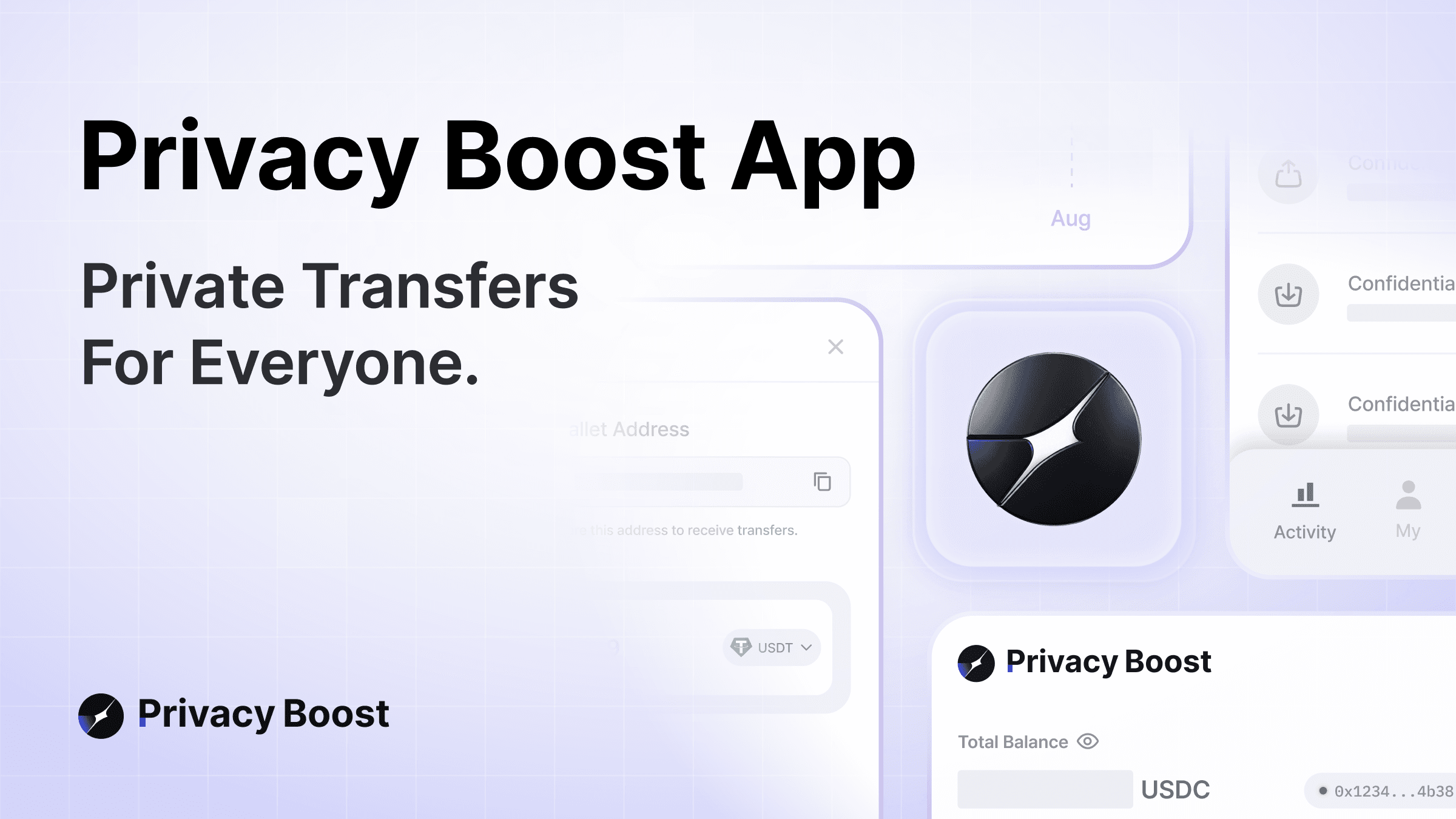
Introducing the Privacy Boost App
Privacy Boost has been enterprise-only until now. Starting today, anyone can manage crypto privately: pay friends, hold positions, and unlink wallets, while staying fully self-custodial.
Partnerships
Friends is live on Startale App: private payments powered by Privacy Boost
Friends is a Mini App on Startale App that lets you send money onchain without putting your payment history on display. It's powered by Privacy Boost, bringing shielded transfers to every user on Soneium.